Showing posts with label Dewey. Show all posts

Saturday, October 20, 2018

Time for a Deweyan revival

"Democracy needs to be reborn in each generation, and education is its midwife." -- John Dewey
The great American educator and philosopher, John Dewey, was born on this day in 1859. Dewey was the guiding light behind the progressive education movement of the last century and still is, for those of us who still value progressive and democratic ideals and educational practices.

In 1916, John Dewey published “Democracy and Education,” which advocated for placing the child, as opposed to the curriculum, at the center of the classroom. Dewey saw education as a social interaction between children and adults, and believed that knowledge couldn’t simply be given to a child, but that a student must experience something and engage with it to learn.

But today, after decades of No Child Left Behind, Race To The Top, and Trump/DeVos, there are only small traces left of Deweyan influence on public school policy. There were brief revivals during the Civil Rights Movement of the '60s (Freedom Schools Citizenship Schools in the south and alternative schools in the north) and then during the Small Schools Movement of the 1990s. But today, those examples and other have been pretty much crushed or co-opted by corporate "reform", testing madness, and privately-run charter schools.

Now in fact, the very survival of public education is in doubt as the hard-won gains of the Civil Rights Movement are being rolled back under the current Dept. of Education and right-wing state governments. Privatization, resegregation and the erosion of all public space and public-decision making mark the current trends in education. Higher education is increasingly an unaffordable commodity for all but the children of the wealthy.  

It's time for a Deweyan democratic revival in school and society. 

Saturday, September 9, 2017

These Schools Belong to You and Me

My old and dear friend Deb Meier and her former Mission Hill School colleague and co-writer, Emily Gasoi have a new book out and it's well worth the read. These Schools Belong to You and Me is an elegantly-written call to defend and preserve the public or democratic part of what's left of public education itself.

They cover a lot of ground in 180 pages, including a biting critique of Trump's Ed Sec. Betsy DeVos, privately-run charter schools, the misnamed "accountability" wave, and Deb's reflection on the cooptation/disembowelment of the small schools movement which she helped launch at Central Park Elementary School in East Harlem more than 40 years ago.

Deb and Emily are among the few practitioners still writing about democracy and education. John Dewey lives.

Tuesday, June 14, 2016

Definitions

Jane Addams, American radical

From Merriam Webster
adjective rad·i·cal \ˈra-di-kəl\
of, relating to, or proceeding from a root: as
a (1) : of or growing from the root of a plant <radical tubers> (2) : growing from the base of a stem, from a rootlike stem, or from a stem that does not rise above the ground <radical leaves>
b : of, relating to, or constituting a linguistic root
c : of or relating to a mathematical root
d : designed to remove the root of a disease or all diseased and potentially diseased tissue <radical surgery> <radical mastectomy>

From the Guardian... "FBI and Obama confirm Omar Mateen was radicalized on the internet."
I still don't see anything radical about a homophobic psychopath with an AR-15. Seems pretty retrograde to me. It's certainly not in the tradition of American radicalism, ie. Radical Republicans who opposed slavery and the Confederacy, socialists like Eugene Debs, Jane Addams, labor organizers like I.W.W. and civil rights heroes in S.N.C.C.


Rendition 
From Merriam Webster
noun ren·di·tion \ren-ˈdi-shən\
: a performance of something

From the Daily Mail..."Under the rendition program, terror suspects were kidnapped on foreign soil and transferred to centers also outside the U.S., where they were interrogated and tortured." 
In CIA-speak, using U.S. embassies abroad to kidnap and torture people is now called "extraordinary rendition".

From CPS website:
Wanted: Executive Director of Personalized Learning 
Another example of how they've taken the language of progressive education and turned it into its opposite. One can only imagine what Personalized Learning means in an organization centered on standardization and testing madness. Possibly plopping more kids down in front of a computer screen for test prep while class size balloons to 40 in a class.

In 1916, John Dewey published “Democracy and Education,” which advocated for placing the child, as opposed to the curriculum, at the center of the classroom. Dewey saw education as a social interaction between children and adults, and believed that knowledge couldn’t simply be given to a child, but that a student must experience something and engage with it to learn.

Have Rahm Emanuel and Forrest Claypool suddenly become Deweyists? Answer: Only for their own kids who attend chi-chi progressive private schools. Not for other people's children.

Wednesday, December 23, 2015

Even under new law, Common Core still impacts curriculum

Abandon the notion of subject-matter as something fixed and ready-made in itself, outside the child's experience. -- John Dewey
Remember back a couple of years ago when Common Core critics were being raked over the coals by Arne Duncan, Peter Cunningham and others for calling CCSS a curriculum?

Here's Duncan in 2013:
The Common Core has become a rallying cry for fringe groups that claim it is a scheme for the federal government to usurp state and local control of what students learn. An op-ed in the New York Times called the Common Core “a radical curriculum.” It is neither radical nor a curriculum. … When the critics can’t persuade you that the Common Core is a curriculum, they make even more outlandish claims.
"It's not a curriculum," they scolded. "It's merely standards." Such a dichotomy! Supposedly, Common Core wouldn't tell schools what, when, or how to teach. Rather, it would only create performance goals and, of course, the battery of tests to go with them.

Well, Duncan was right about Common Core not being "radical." But Common Core sure as hell is curricular. If not, why, for example is there something called Common Core algebra as opposed to just algebra? Or Common Core U.S. History?

A year later, it was Duncan's former deputy, Peter Cunningham, now writing for Eli Broad-funded Education Post, rendering Arne even more profound.
Standards are set at the state level and define learning goals. Curriculum is the actual content that is taught and is usually chosen and developed at the local level, often by the teachers themselves.
Let's leave aside, for a moment at least, the question of whether or not teachers have the power to decide curriculum, and get to Cunningham's main point -- the supposed wall between standards and curriculum.

Bureaucratic non-educators like Duncan and Cunningham don't know a curriculum from a corral. They look at it as simply a technical process.

But curriculum encompasses the entire process and content of teaching/learning. It defines the educational foundations, the experience of the child and teacher, goals and contents, their sequencing in relation to the amount of time available for the learning experiences, the learning environment inside and outside of the classroom, the methods to be used, the resources for learning and teaching (e.g., textbooks and new technologies), evaluation and more.

Fast forward to today... EdWeek reports that Algebra 1 is a much tougher course under the Common Core and that students are now being introduced to algebraic concepts earlier in middle school. As a result, Algebra has become more of a gate-keeper and sorting mechanism than it already was. In New York, this puts even more students in peril of not graduating or going to college, widening the already vast chasm between students from affluent households, and poor, black, Latino and white students.

The percentage of N.Y. students who passed the test this year dropped precipitously: Just 63% of test-takers passed the common-core-aligned exam. That was down from 72% who passed the previous year's "Integrated Algebra" test.

That's thousands of kids who won't be able to graduate high school on time.

Why should Algebra be the gate-keeper as opposed to science, social-studies, or the arts? Who decides what's most worthwhile for all students to learn? Answer: Under Common Core, now re-ratified under the new Every Student Succeeds Act (ESSA) signed by President Obama this month, it's still not educators who decide -- despite Cunningham's claim.

More from EdWeek...
Common-core implementation has been fraught in New York. Many teachers denounced the speed with which they were expected to shift to the new standards, saying they lacked sufficient training and resources. 
True, some authority has been shifted from the D.O.E. to the states -- an admission that the feds had overplayed their role under Duncan's regime -- but what is tested, either by the states or the feds, is still what's being taught.

ESSA supporters, including the AFT and NEA leadership, say the new law gives states the right to reject the standards, which they say should help end any controversy over top-down control.

But is giving more power to Mississippi or Alabama pols over curricular decisions a good thing? Not in my mind. And besides, despite claims by Republicans like ESSA co-author Sen. Lamar Alexander, that the new law gets rid of Common Core, it's just not true.

No, under the ESSA, the U.S. Department of Education retains regulatory powers, including the final say on how and when states determine schools are low-performing. The law also maintains annual testing requirements for grades 3-8 and in high school. And it will still be the giant textbook and testing companies who have the real power in driving curriculum.

Monday, March 2, 2015

What we can learn from Escuela Nueva

Decades ago, John Dewey, America’s foremost education philosopher, asserted that students learned best through experience and that democracy “cannot go forward unless the intelligence of the mass of people is educated to understand the social realities of their own time.” 
I'm not a big educational "models" guy. But it's hard to argue with this one.

Escuela Nueva is an educational model designed in Colombia in the mid 1970’s by Vicky Colbert, Beryl Levinger, and Óscar Mogollón to improve the quality, relevance and effectiveness of the schools in the country. With simple, concrete strategies, Escuela Nueva promotes a classroom environment where students actively learn, participate, and collaborate; and strengthens the relationship between the school and the community. It is a flexible educational model tailored to meet the needs of each individual child, allowing students to complete units and advance to higher grade levels at their own pace.

A 1992 World Bank evaluation of Colombia’s schools concluded that poor youngsters educated this way — learning by doing, rather than being endlessly drilled for national exams — generally outperformed their better-off peers in traditional schools. A 2000 Unesco study found that, next to Cuba, Colombia did the best job in Latin America of educating children in rural areas, where most of the schools operate with this model.

This reminds me of the kind of research that was done in Ralph Tyler's renown "Eight-Year Study" (1933–1941) which compared the academic success rates of students in traditional and progressive alternative schools. In his widely read and used, post-study book, Basic Principles of Curriculum and Instruction (1949), Tyler popularized the lessons from the study and described learning as taking place through the action of the student. "It is what he does that he learns, not what the teacher does."

According to U.C. Berkeley Prof David Kirp, writing in the N.Y. Times:
Escuela Nueva turns the schoolhouse into a laboratory for democracy. Rather than being run as a mini-dictatorship, with the principal as its unquestioned leader, the school operates as a self-governing community, where teachers, parents and students have a real say in how it is run. When teachers unfamiliar with this approach are assigned to these schools, it’s often the students themselves who teach them how to apply the method. “In these schools, citizenship isn’t abstract theory, It’s daily practice.
Rachel Lotan, a professor emeritus at Stanford, is quoted the Times story:
“Doing well on the high-stakes test scores is what drives the public schools, and administrators fear that giving students more control of their own education will bring down those scores.” Officials, and those who set the policies they follow, would do well to visit Colombia, where Escuela Nueva has much to teach us about how best to educate our children.
The question is, can a model of democratic education take root in a country like this one where testing, sorting and tracking students is the name of the game?

Saturday, February 7, 2015

More on 'Dare the School Create a New Social Order?'

I had no idea that my reference to George Counts' little book would arouse such passionate arguments (see comments section) against the notion of the school as a force for social reconstruction. I hope others will join in on this important conversation.

Of course neither schools -- nor any other single institution or social force -- can transform society, provide jobs, housing or end poverty and racism by itself. But thanks to my friends Diane Ravitch and Deb Meier for pointing that out once again. Of course, I was raising much broader issues, like the growing threat of nuclear annihilation and environmental catastrophe in my post.

Deb calls it a "Utopian" idea that will only "set teachers up" for failure. But I think there's power in Utopian ideas. I'm reminded here of  John Dewey's imagined visit to Utopia written up in a 1933 New York Times article, which influenced many involved in 60's youth revolt, which was built on the imagination of a better world in which to grow up. Or for that matter, the 1990's small schools movement.

Dewey wrote:
The most Utopian thing in Utopia is that there are no schools at all. Education is carried on without anything of the nature of schools, or, if this idea is so extreme that we cannot conceive of it as educational at all, then we may say nothing of the sort at present we know as schools.
Children, however, are gathered together in association with older and more mature people who direct their activity.  The assembly places all have large grounds, gardens, orchards, greenhouses, and none of the buildings in which children and older people gather will hold much more than 200 people, this having been found to be about the limits of close, intimate personal acquaintance on the part of people who associate together.
Yes, we have to separate (and connect) visions and dreams from/with daily classroom practical problem solving. But the question remains: What can must schools do?

Counts and Dewey's critique of fellow progressive educators is as relevant today as it was 80 years ago. Despite wishes that child-centered education could take place free from political and ideological struggle, schools remain contested territory. And why not? They are the places where future generations should be being prepared to become citizens in a participatory democracy rather than merely centers of social-reproduction (structures and activities that transmit social inequality from one generation to the next).

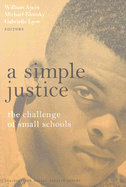
The best examples of democratic education I can come up with are the Freedom Schools and Citizen Schools that were a critical part of the 60's-era Civil Rights Movement. It's worth reading Charles Payne's book, I've Got The Light of Freedom on this, along with his chapter, Education for Activism: Mississippi's Freedom Schools in the 1960s" in Ayers, Klonsky & Lyon, A Simple Justice.

Yes, there is always the risk that schools and teachers will try to, or be asked to carry too much of the social change burden or substitute indoctrination for the development of reflective and critical thinking skills. But the greater risk, it seems to me, is the acceptance of school in its traditional form, bound by a common core curriculum, prescribed blocks of subject matter and standardized testing.

As for jobs and housing, it's worth noting that unlike 1932, those things are profoundly influenced by schools in a society where education has become the second largest sector of the GNP, trailing only healthcare. That's much too large a share, in the minds of corporate school reformers, to be left in the hands of democratic decision makers. Education is rapidly becoming a $1 trillion industry, representing 10% of America's GNP. Federal and State expenditures on education exceed $750 billion and education companies, with over $80 billion in annual revenues, already constitute a large sector in the education arena.

There are more than 4 million teachers and many more non-teaching workers and teacher unions remain the largest in the country and may be our last bastion of organized labor.

Yes, the schools remain a battle ground. So I guess I would argue that schools, students, and educators can, should and must "dare to create a new social order". The very survival of the planet may depend on it.

Wednesday, February 4, 2015

More than 80 years ago, Counts asked, "Dare the school build a new social order?"

“The urgency is real. We are not saying that it is too late to take actions, but the window for action is closing rapidly. The choice is ours, and the clock is ticking.” -- Bulletin of Atomic Scientists Executive Director Kennette Benedict
Back in 1932, George S. Counts asked his colleagues in the Progressive Education Association, "Dare the School Build a New Social Order?" Counts, who was influenced by progressives like John Dewey and Francis Parker, favored the progressive education model of child-centered learning. But he and other social-reconstructionists feared that school curriculum, even in progressive schools, was being sanitized and separated from the real social conditions like the Great Depression and the global crisis caused by the rise of fascism in Europe and the threat of a new world war. He called for a "critical pedagogy" that might produce a new generation of social justice activists, capable of "reconstituting the democratic tradition and of thus working positively toward a new society".

I'm thinking about Counts' challenge to the educators of his time this morning, as I'm reading that the board of the Bulletin of the Atomic Scientists (BAS) has decided to move the minute hand on its symbolic Doomsday Clock 2 minutes closer to disaster. The clock now shows 3 minutes before midnight because the “probability of global catastrophe is very high” as a result of continuing climate change and efforts to modernize nuclear weapons stockpiles. The BAS board includes more than 20 scientists, 17 of whom are Nobel laureates.

It's stunning that the clock should move this far, even after six years of a liberal and self-proclaimed progressive, Democratic Obama administration which pledged to "set a goal of a world without nuclear weapons, and pursue it." Sad to say that the pace of dismantling our massive stockpile of nuclear weapons has slowed nearly to a stand still and the development of new weapons of mass destruction and modernized delivery systems is rapidly moving forward. And now the threat of a new Cold War with Russia is growing stronger.

Global greenhouse gas emission rates are now 50% higher than they were in 1990. Emission rates have risen since 2000 by more than in the previous three decades combined. Investments have continued to pour into fossil fuel infrastructure at a rate that exceeds $1 trillion per year, with additional hundreds of billions of dollars in continued fossil fuel subsidies.

Faced with this global crisis and rising poverty and racial oppression (the new Jim Crow) here at home, the question of the role of teachers and schools is back on the table as is the question posed to progressive educators by Counts more than 80 years ago.

Monday, May 12, 2014

WEEKEND QUOTABLES

Principal Troy LaRaviere
So when people ask me, “Aren’t you afraid of losing your job if you speak out?” this is my answer: I did not travel across an ocean and risk my life to defend American freedoms only to return and relinquish those freedoms to an elected official and his appointed board of education. -- Sun-Times
Valerie Leonard, N. Lawndale community activist
 "It's depressing. What we're seeing is a consolidation of our schools under private interests. For us as a community, we're the ones that are bearing the brunt of all this." -- Tribune
Parent Nivia Simmons
"There's so many kids in the area and there's not enough schools. When they closed down schools, class sizes went up. And for parents who have to work or they don't have a car, their options have been taken away." -- Private operators dominate public schools in North Lawndale
UC Berkeley Prof. Bruce Fuller
“It’s like putting a Burger King kitty-corner to a McDonald’s and expecting — in the same location and competing for the same families — warm and fuzzy cooperation." -- NYT: Charters, Public Schools and a Chasm Between
Paul Krugman
First, modern inequality isn’t about graduates. It’s about oligarchs. Apologists for soaring inequality almost always try to disguise the gigantic incomes of the truly rich by hiding them in a crowd of the merely affluent. -- New York Times

Monday, March 10, 2014

True 'grit'

The next of my fellow academics who mentions the word "grit" to me is going to feel the wrath of my electric sander on their behind. This latest in a long line ed clichés, has become the buzzword du jour of the no-excuses, corporate school reformers like University of Pennsylvania psychologist Angela Duckworth, who claim that grit is the critical ingredient to academic success. The notion was popularized in Paul Tough's book, How Children Succeed and has become the 2014 version of telling poor kids to pull themselves up by their own bootstraps. 

Thanks to Pedro Noguera and Anindya Kundu for this gritty response the other day on MSNBC.
More often than not, we discuss disparities in student performance in isolation from other factors that contribute to them, such as inequity in per pupil spending. If instead of posing the problem as an “achievement gap” which reinforces the idea that individual effort is the key factor determining differences in outcomes, we acknowledged it as an “opportunity gap,” we might do much more to address the disparities that limit the ability of children to learn.
Social science research has consistently shown that public school students with higher-income parents are likelier to attain higher levels of education than their lower-income peers. The United States continues to have the highest income inequality among first-world nations, and all the grit in the world will not change that. -- "Why students need more than ‘grit’".
KIPP charter in New Orleans
If Duckworth's name sounds familiar to readers of this blog, it's because I mentioned her in a post last December which focused on her boss, Martin Seligman, director of Penn's Positive Psychology Center, and the guru behind KIPP Charter Schools. Seligman's positive-psychology experiments were also used by the Bush Administration to develop its so-called advanced interrogation techniques used at Guantanamo.

These behavior-modification theories, now being applied to the field of ed reform as well as GITMO's torture chambers, have little in common with the philosophy of  John Dewey and other progressives who often focused on encouraging intellectual freedom and fostering creative intelligence, self-discipline, and social ethic necessary for students to find a meaningful and productive place within both their local community and the world. It was largely these ideas which drove the early small-schools movement of the 1990s.

That's not what the new grit-ists have in mind.

Monday, October 21, 2013

WEEKEND QUOTABLES

Daley doesn't know what he knew.
Classic Daley under oath
 “I don’t know what I knew.” -- Sun-Times
Diane Ravitch
NPR says Rahm Emanuel gets a “mixed” grade at midterm. On education, his grade is not mixed. It is a big fat F.  -- Grading Rahm Emanuel 
IL Sen. Pres. John Cullerton
The state's massive public employee pension debt is not a "crisis," but instead an issue being pushed by business-backed groups seeking lower income taxes at the expense of retiree benefits. -- WGN interview 
John Dewey
D.C. whistle-blower principal, Adell Cothorne 
I was a principal in a Washington DC public school when IMPACT was being rolled out. I knew of other principals who had their secretaries fill out the complex teacher rating systems for them. In other words, there were no safe guards to ensure that the system wasn’t being manipulated. How can we justify a rating system that can be gamed? -- EduShyster
John Dewey
"Democracy needs to be reborn in each generation, and education is its midwife." -- Chicago Tribune Commentary

Thursday, September 19, 2013

Life of an ed blogger

"What the best and wisest parent wants for his own child, that must the community want for all of its children. Any other ideal for our schools is narrow and unlovely; acted upon it destroys our democracy." -- John Dewey, School & Society
Every day my mailbox is filled with requests from different promoters, asking me to pimp pump their products, their programs, and their private and charter schools. Urban public schools have no publicists.

Looks like fun, doesn't it?
I have no idea why some of these folks think I would want to promote them. But sometimes I do, unintentionally. Case in point, this morning I got this missive from Glenn Gray, who promotes something called the Heritage Academy.

Hi Mike, [they always address me by my first name]
Heritage Academy – a progressive, coeducational school (grades 5-12) located on Hilton Head Island – announces a fall class representing 25 countries and 20 U.S. states. A record 11 different activities are featured this year, including aviation, ballroom dance, crew, equestrian, fast track education, golf, interior design, swimming, modern dance, tennis and volunteering. High res images are available upon request. Thank you for your consideration.
Tuition at Heritage is a modest $15K/year. Modest that is, when compared to Chicago's new elite GEM Academy, which runs from $32-$37K. Let's just say, it's not for everybody.

Usually, I just do a quick run-through of the morning mail and hit the delete button 20 times. Problem solved. But I couldn't help myself on this one. I think it was the word progressive that jumped out on me.

Few public schools would dare call themselves progressive in this, the age of Race To The Top, testing madness, and corporate "reform." They would run the risk of being "reformed" out of existence. Yet this chic private academy on Hilton Head, whose curriculum is loaded with every subject the children of the rich need to learn in order to join the country's ruling class -- did they forget polo and fox hunting? -- pitches itself to its target audience as a "progressive" alternative.

Jean Anyon
It brought to mind research by the late Jean Anyon on the class nature of curriculum. Anyon studied the experiences of children in working class, middle class and wealthy elite schools. In the elite schools, she found, for example:
While strict attention to the lesson at hand is required, the teachers make relatively little attempt to regulate the movement of the children at other times. For example, except for the kindergartners the children in this school do not have to wait for the bell to ring in the morning; they may go to their classroom when they arrive at school. Fifth graders often came early to read, to finish work, or to catch up. After the first two months of school, the fifth-grade teachers did not line the children up to change classes or to go to gym, and so on, but, when the children were ready and quiet, they were told they could go--sometimes without the teachers. -- Social Class and the Hidden Curriculum of Work
Peter Orrell, President and CEO of Junior Sports Corporation, owner/operator of the Heritage Academy puts it this way.
“To position students for success at the next level, we promote individual and differentiated attention in each classroom.”
Yes, progressive in form. But missing progressive education's democratic heart. "Progressive" ed, learning through doing, connection with the world of work, for the elite. Race To The Top, testing madness and intellectual rigor mortis for the rest.

Glad to help, Glenn.

Friday, June 7, 2013

The end of Europe?

Cabo Da Roca, the end of Europe
That's the ominous name given to the wild, rocky coast on the westernmost end of Portugal. On another level, lots of folks here are talking about the end of Europe. While I don't believe that the end  is in sight, the standard of living here is in free-fall and millions of people are truly suffering under imposed austerity and are ready for change. Educators are a big part of the protest movement and lots of debate is taking place over the role of schooling in Portuguese society.

I know,  I'm supposed to be on vacation.  And believe me, we've been taking that seriously, enjoying great seafood, taking in the music and art, visiting Moorish castles and hitting the beaches and all that good stuff. Not to mention, getting up at 2 a.m. to watch the Spurs beat the Heat in game 1.

CGTP's Fernando Mauricio
But I'm also drawn to the complex political life of Portugal, both for its role as a brutal colonizer in Africa and for its 1974-75 "Carnation Revolution," which toppled the fascist Salazar dictatorship. The revolution helped the emerging liberation movements in Portugal's former colonies win their independence in 1975. Every country has its two sides and I like to see them both.

During a break in sightseeing, we were able to visit with Fernando Mauricio, one of the leaders of the CGTP, Portugal's largest union, which along with the smaller and not-so-militant rival UGT, is organizing for the upcoming general strike.  Fernando, who was a public school teacher before becoming a union organizer, gave us an update on the current struggle and some background on the history of the union movement here. As a young political activist in the 1960a and 70s, he spent time in prison and underground and in exile during the years of the dictatorship.

Students at Bento de Jesus Caraça High School
We also got to visit and meet with the leaders of Bento de Jesus Caraça Vocational High School, one of half a dozen public schools run by the union -- this one housed in  the union's downtown Lisbon headquarters. It's named after the revolutionary Portuguese educator who was a notable figure both in the field of popular education and in the resistance movement against Salazar dictatorship.

The classrooms are airy and inviting. The view from the classroom windows out over the Tagus River is so beautiful,  if I were a student here I'd have a tough time focusing on my lessons.

The school's curriculum, while called voc-ed, is really about educating the whole child and providing a step up towards either  university or  career. It includes a mix of technical skill-building and general core courses--science, languages, arts, social studies, etc... Assessments are mainly performance-based, although all Portuguese students must pass exit exams to graduate. Caraça represents, at least to me, a kind of mixture of John Dewey and Paulo Freire.

Caraça talked about "a school that is life" and the school's philosophy is laid out in a book presented to us, called A School For Life, which includes this statement of purpose:
"Looking at the students as a whole -- taking into consideration their personalities, backgrounds, and aspirations, and not just as recipients of knowledge or as future professionals... Our school has small clusters, which allows a human approach to all situations."
Not bad.

Thursday, May 2, 2013

What the "best and wisest" parents want for their own kids... [Updated*]

Karen and Arne Duncan (U.S. DOE photo)
Back in 2011, I was taken by this open letter from Arne Duncan and his wife Karen to their two children, Claire and Ryan, on the opening of the school year. The letter, cross-posted on the DOE's Homeroom blog and Parenting.com, showed the Duncans as thoughtful and caring parents, deeply concerned about their own children's education, welfare, hopes and dreams for the future. 

The letter gave us some insight into what the former Chicago schools CEO and the nation's second-term Secretary of Education thought was best when it came to public schooling.
Our hope for you this year is that you will be challenged academically. You have some terrific teachers to support you. We want your love of literature to grow, and we’ll do our part by reading to you every night. We hope you will develop critical thinking skills in math, and we promise to help you when you’re struggling and celebrate when you’re succeeding. We would like to see you engaged in learning science, civics, and history, and we will continue to explore the natural world at nature centers, museums, and many of the other great resources in the Washington area. 
We also want you to enjoy so many other enriching experiences that are so important to a complete education. We know you have great music, art, and physical education teachers at your school, and we believe that these subjects are essential for a well-rounded curriculum. And so is recess. We want you to have fun!
I'm sure many of these ideas were formed from Arne's own experience as a young student at the elite University of Chicago Lab School, a place where classes are small, where the arts flourish and where standardized testing is devalued. Mayor Rahm Emanuel sends his children to Lab.

Once at the DOE, the Duncans wouldn't settle for D.C. public schools for Claire and Ryan -- not even when their favorite reformer, Michelle Rhee, became the school chancellor. Instead they bought a house across the Potomac in an upscale Arlington, Va. neighborhood where the schools are top-notch, including small class sizes and lots of dollars spent to keep them that way.

Now comes the news that during Arne's time as Chicago's school chief, the Duncans held a secret list. It included the names of clout-heavy political donors, local politicians and billionaires like Bruce Rauner, who wanted their otherwise unqualified children admitted through the back door to one of  the city's elite selective-enrollment schools. While a strict testing regimen was being implemented across the district, with arts being cut and recess banned, all the VIPs needed to do was make a phone call and either Arne or Karen would put their initials, AD or KD. next to their patron's name, and the back door to top-tier schools like Walter Payton College Prep would open wide.

Over a century ago, Lab School founder and our greatest educational philosopher John Dewey wrote in School and Society:  "What the best and wisest parent wants for his child, that must we want for all the children of the community. Anything less is unlovely, and left unchecked, destroys our democracy.”

Arne must have slept through that class at Lab.

Wednesday, February 2, 2011

Why compare Ohio mom to Rosa Parks?


After last night's Twitter discussion with some of my favorite folks, including Nancy Flanagan and David Cohen, I posted this comment in response to Nancy's post, "Equal Access: Rosa Parks, Lite" on her Teacher in a Strange Land blog at Edweek.

******

Good post Nancy.

Valerie Strauss (my favorite ed columnist) was wrong to make the comparison between Williams-Bolar and Rosa Parks. It sounded patronizing and wasn't helpful. Who among us could live up to that standard?

Of course, when white, advantaged parents seek out the "best school" for their kids (often as far away from  impoverished and isolated communities as possible) they are within the law. Why? The law, as it was 55 years ago when Mrs. Parks took her famous bus ride, reinforces, (now de facto),  segregation, or as Jon Kozol calls it, apartheid schooling.

People will resist our current segregated and increasingly 2-tier system of schooling  in whichever ways are available to them. Even the most liberal among us are often protective of the privileges we expect for our own children--privileges that occur only because we may be white or can afford a house in an affluent neighborhood. Of course we tsk, tsk at the thought of  Williams-Bolar being jailed but then somehow feel the need to compare her negatively to Mrs. Parks for lying on a form in order  to put her child with ours.

I like the way you put it: "There has to be something for everyone in building a truly equitable system, or it will never be built. When open access to quality education requires fraud, we're all in trouble."

Of course there's fraud and fraud, just like there's theft and theft. An impoverished mom stealing baby food for her hungry child is not a thief in the same sense as a Bernie Madoff. And we would see no need to make the comparison between her and Rosa Parks.

As John Dewey wrote: “What the best and wisest parent wants for his own child, that must the community want for all its children.”

******

Valerie Strauss' Answer Sheet column, "Not a Rosa Parks Moment" in the Washington Post can be found here. In fairness, I think that Valerie's commentary was aimed mainly at conservative "choice" advocates rather than at Mrs. Williams-Bolar. They were the ones who cynically raised the Rosa Parks banner, as if...

Also worth reading is a commentary by Dewayne Wickham in the Ohio NewsLeader, "Failed educational system forced Ohio mom to act desperately."

Monday, April 26, 2010

WEEKEND QUOTABLES

Maybe they mean this Dewey...

Newbie instructors too often emerge from ed school stuffed with the ideas of everyone from Thomas Dewey to Brazillian Marxist theorist  Paulo Freire (author of "Pedagogy of the Oppressed") - but clueless about how to help kids learn. (N.Y. Daily News editorial bashing schools of education)
Mass. testing madness
MCAS has a decidedly negative effect on the humanities and the arts. With the excessive preoccupation on testing in English and math (and now science), there is no room or energy for becoming human. (Anthony J. Palmer, visiting scholar at the School of Music at Boston University)
When they start talking "innovation," DUCK!
"Even if the reform bill does bring stringent regulation to derivatives — a big if — that won’t rectify capitalism’s worst “innovation” in our own Gilded Age: the advent of exotic, speculative “investments” that have no redeeming social value and are instead concocted to facilitate gambling for its own sake." (Frank Rich)

D.C. Superior Court judge questions legality of Rhee teacher firings
"The issue is now whether it was reasonable for the chancellor to believe last fall that there was a budget shortfall to justify" the layoffs. (WaPo)