Showing posts with label Deb Meier. Show all posts

Monday, September 25, 2017

WEEKEND QUOTABLES

Columnist Mary Mitchell: "But the privileged class doesn’t get to tell the oppressed class how they should react to oppression." -- Sun-Times
Deborah Meier
If it’s such a wonderful idea, democracy, why don’t at least the adults who make up the school operate democratically? Why don’t we provide the time and space so students can witness it and over time can become more and more part of it as they grow older, so by the time they graduate at 18 and are full citizens with the right to vote, they’ve had a long apprenticeship in what it means to be a citizen. -- EdWeek interview 
CTU Pres. Karen Lewis 
 “We should not be surprised by this most recent ethics breach by Claypool and his CPS general counsel, Ronald Marmer. These are not people who care about our public schools or the public trust.” -- Sun-Times 
David Orr & Steve Valles on Hitting Left
Stevie Valles, Exec. Director of Chicago Votes
"We're the most progressive generation in the history of politics". -- Hitting Left
Donald Trump
“These are Alabama values — I understand the people of Alabama. I feel like I’m from Alabama, frankly." -- Washington Post 
Sports writer Rick Morrissey
Calling any player who kneels during the national anthem a “son of a bitch,’’ as Trump did, and doing it in Alabama, as Trump did, is beyond code for “African-American.’’ If he had said “uppity,’’ he wouldn’t have been any clearer. -- Sun-Times
Former NFLer Chris Kluwe 
“Well, I think that the players and the teams are saying that they are not going to be dictated to by a racist, fascist white supremacist who currently occupies the highest place in our government...this is not what America is.” -- CNN


Saturday, September 9, 2017

These Schools Belong to You and Me

My old and dear friend Deb Meier and her former Mission Hill School colleague and co-writer, Emily Gasoi have a new book out and it's well worth the read. These Schools Belong to You and Me is an elegantly-written call to defend and preserve the public or democratic part of what's left of public education itself.

They cover a lot of ground in 180 pages, including a biting critique of Trump's Ed Sec. Betsy DeVos, privately-run charter schools, the misnamed "accountability" wave, and Deb's reflection on the cooptation/disembowelment of the small schools movement which she helped launch at Central Park Elementary School in East Harlem more than 40 years ago.

Deb and Emily are among the few practitioners still writing about democracy and education. John Dewey lives.

Tuesday, February 16, 2016

On the so-called 'failure' of the small schools movement

Holy Cross prof, Jack Schneider, writing at EdWeek, makes a pretty fair assessment of the small schools movement.
In the eyes of Gates and company, the problem was with small schools as a particular policy fix rather than with the thinking behind the fix. Collective faith in silver bullets—in finding "what works" and "taking it to scale"—remained absolute. Never mind the obvious disregard for the importance of context or inescapable complexity of improving schools. The backers declared small schools a failure and moved on.
But while the modern small schools movement, which began as a teacher-led movement in East Harlem, for social-justice and democratic education and met its death when it was trampled by the top-down, corporate-style reform wave of the past two decades, was never envisioned as a panacea or a technical reform for ailing schools. Rather it was seen by us early educator/activists as a way to drive change from below. Small, was about far more than the size of buildings or even school population. It was a metaphor that gave us a way to confront anonymity and talk about schooling in personalized, human terms.

Gates money, translated into Gates' takeover and proved to be the irresistible kiss of death, as many of us suspected it would be.

Writes Schneider:
As it turns out, small schools do exactly what you might expect. Smallness can create more opportunities for young people to be known, both by one another and by the adults in the building. The relative intimacy of small schools can foster trusting, caring, and attentive relationships. Deborah Meier, the godmother of the small-schools movement, consistently made this argument in the 1980s and 1990s when explaining the importance of size. As she put it in a 1989 op-ed essay, small schools offer young people better opportunities to learn forms of participation" necessary to becoming a member of a democratic society." But they are, at best, only one piece of a complex puzzle. And early proponents of small schools were clear about that. As Meier, who also writes an opinion blog for Education Week , prudently observed: "Small schools are not the answer, but without them none of the proposed answers stand a chance."
For more on the life and death of the small schools movement, read our book, "Small Schools: Public School Reform Meets the Ownership Society." Maybe it's time to reopen the conversation on small schools.

Friday, April 24, 2015

Deb Meier


Special thanks to my friend Deb Meier for spending time with our group of local educators Wednesday and my doc students last night. Discussion topics ranged from Habits of Mind, to misuse of testing, to early childhood play, to the small schools movement. Deb is in town for AERA and for the upcoming NPE Conference where she is participating in three panel discussions on Saturday. You can keep up with Deb at deborahmeier.com/

Saturday, February 7, 2015

More on 'Dare the School Create a New Social Order?'

I had no idea that my reference to George Counts' little book would arouse such passionate arguments (see comments section) against the notion of the school as a force for social reconstruction. I hope others will join in on this important conversation.

Of course neither schools -- nor any other single institution or social force -- can transform society, provide jobs, housing or end poverty and racism by itself. But thanks to my friends Diane Ravitch and Deb Meier for pointing that out once again. Of course, I was raising much broader issues, like the growing threat of nuclear annihilation and environmental catastrophe in my post.

Deb calls it a "Utopian" idea that will only "set teachers up" for failure. But I think there's power in Utopian ideas. I'm reminded here of  John Dewey's imagined visit to Utopia written up in a 1933 New York Times article, which influenced many involved in 60's youth revolt, which was built on the imagination of a better world in which to grow up. Or for that matter, the 1990's small schools movement.

Dewey wrote:
The most Utopian thing in Utopia is that there are no schools at all. Education is carried on without anything of the nature of schools, or, if this idea is so extreme that we cannot conceive of it as educational at all, then we may say nothing of the sort at present we know as schools.
Children, however, are gathered together in association with older and more mature people who direct their activity.  The assembly places all have large grounds, gardens, orchards, greenhouses, and none of the buildings in which children and older people gather will hold much more than 200 people, this having been found to be about the limits of close, intimate personal acquaintance on the part of people who associate together.
Yes, we have to separate (and connect) visions and dreams from/with daily classroom practical problem solving. But the question remains: What can must schools do?

Counts and Dewey's critique of fellow progressive educators is as relevant today as it was 80 years ago. Despite wishes that child-centered education could take place free from political and ideological struggle, schools remain contested territory. And why not? They are the places where future generations should be being prepared to become citizens in a participatory democracy rather than merely centers of social-reproduction (structures and activities that transmit social inequality from one generation to the next).

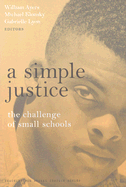
The best examples of democratic education I can come up with are the Freedom Schools and Citizen Schools that were a critical part of the 60's-era Civil Rights Movement. It's worth reading Charles Payne's book, I've Got The Light of Freedom on this, along with his chapter, Education for Activism: Mississippi's Freedom Schools in the 1960s" in Ayers, Klonsky & Lyon, A Simple Justice.

Yes, there is always the risk that schools and teachers will try to, or be asked to carry too much of the social change burden or substitute indoctrination for the development of reflective and critical thinking skills. But the greater risk, it seems to me, is the acceptance of school in its traditional form, bound by a common core curriculum, prescribed blocks of subject matter and standardized testing.

As for jobs and housing, it's worth noting that unlike 1932, those things are profoundly influenced by schools in a society where education has become the second largest sector of the GNP, trailing only healthcare. That's much too large a share, in the minds of corporate school reformers, to be left in the hands of democratic decision makers. Education is rapidly becoming a $1 trillion industry, representing 10% of America's GNP. Federal and State expenditures on education exceed $750 billion and education companies, with over $80 billion in annual revenues, already constitute a large sector in the education arena.

There are more than 4 million teachers and many more non-teaching workers and teacher unions remain the largest in the country and may be our last bastion of organized labor.

Yes, the schools remain a battle ground. So I guess I would argue that schools, students, and educators can, should and must "dare to create a new social order". The very survival of the planet may depend on it.

Thursday, April 10, 2014

Packed house at Wishbone to honor ISAT boycotters

Parents 4 Teachers
Jambalaya...We dined at Wishbone last night, along with hundreds of others who came out to honor and support ISAT-boycotting teachers and parents. Great people, food and music.

Question for anti-taxers... Why isn't Rahm's pension "reform" bill considered a massive 29% TAX on public workers and the elderly? Also, the accompanying increase in property taxes will hit retirees and others on fixed income, doubly hard. Finally, we already know that relying on property taxes, rather than a more progressive state income tax, to fund our schools is part of the problem -- not the solution. Asking the wealthy and the state's corporations to pay their fair share would help solve the problem. But Boss Madigan won't do it.

Hammerin' Hank
Earlier this week, the Illinois House and Senate approved Emanuel’s plan to raise property taxes by $250 million and employee contributions by 29% over five years to shore up the Municipal Employees and Laborers Pension funds. Now it's up to Gov. Quinn to sign on as he did with the previous pension-robbing SBI. CTU Pres. Karen Lewis is pressuring Quinn not to sign, but rather to open up negotiations with the unions.

Quotable Hank Aaron... "The bigger difference is that back then they had hoods. Now they have neckties and starched shirts." -- NewsMax

Guess who will be posting with birthday girl (83) Deborah Meier on upcoming Bridging Differences blogs over at EdWeek? I'm renaming it, Burning Bridges. Happy birthday, Deb. I guess I'm your birthday present. You can return it if it doesn't fit.


Friday, November 15, 2013

'Hope springs eternal...'


Yesterday was the first official day of basketball practice. Alexander Pope said, "Hope springs eternal." Well, at least in November before we've played our first game. I've got a promising squad of hard-working, fun-loving kids and even have some height for a change. What Pope didn't say is that "you can't teach height". That was the old Utah Jazz coach, Frank Layden 

Great news! Diane Ravitch's health has improved (I'm certain it was my matzo ball soup that did the trick) and she has been cleared by her doctors to travel to Chicago to speak on January 11th.

Saintly and patiently progressive Deb Meier lays out her views on democratic education in yet another round of debates at Bridging Differences. This time she's trying to find common ground with traditionalist educator and Common Core advocate, Robert Pondiscio. Pondiscio wrote in the Atlantic that he once considered himself a progressive teacher but now believes that he "damaged" his poor and urban students by teaching self-expressive writing instead of focusing on grammar, sentence structure, and mechanics (as if the two were separable to a good teacher).

Hopefully, this go-around will be a better than the last one when Deb took on the insufferable think-tank hack, Michael Petrilli. Makes me nostalgic for the days of the Meier/Ravitch blog tussles.

Arne Duncan's new flavor of the month is Career Education.

So I've changed my reform plan. Earlier I had advised Chicago schools to militarize their names, ie. Special Forces High School or Navy Seals Elementary, if they wanted to get adequate funding and survive the latest round of "reform."  But nationally, now I'm leaning more towards simply adding the words Career Academy to the school name in order to receive federal funding under Race To The Top. Take the case of Dunbar Early College High School in Dayton.

This from Huffington:
Dunbar was labeled underperforming, so in 2010, the school received money for an overhaul from the federal government, a favorite Duncan project known as "School Improvement Grants." At a later step in that transformation, Dunbar reinvented itself as an "early college" school. But recent visits to schools such as Dunbar, and Duncan's late October visit with President Barack Obama to a New York City school run in partnership with IBM, show that this mentality is shifting, at least rhetorically. At Pathways in Technology Early College High School in New York, Obama called on Congress to fund career education programs to help bolster the economy.
What's in a name? Shakespeare asked. Plenty, when it comes to funding schools.

Thursday, August 22, 2013

Rahm's press corps reduced to doing damage control

My favorite S-T headline. But just who is EVERBODY anyway?
"If you want to throw something at the cameras, go ahead, have at it. You let ‘em know the City of Chicago is on watch for the children of Chicago.” -- Rahm Emanuel
The mayor's war chest is overstuffed with money. He has the political backing of many of the biggest and richest  players in both political parties, including the POTUS. He has as yet, no announced opponent in the upcoming election. His expensive City Hall and CPS media spinners need an entire floor to fit them all in and his golf buddies even own the Sun-Times. .

My question then is, why is his press coverage so bad? Why is his message so out of control? Why does it seem like his PR people have been reduced to doing damage control and just about every editorial in both papers are dissing him and especially his ed policies?

Possible answers--
  • It's because Rahm is such a a-hole that every reporter in town hates him.
  • It's because his policies, especially around the school closings, are hurting so many people that there's just no credibility left in positive news play.
  • There's so much internal corruption in this administration that no one wants to risk going down with the ship.
  • Rahm is losing it. Can't control his outbursts or be trusted to stay on message, especially when he's under pressure. 
But all this means nothing unless the city's scattered, local-issue oriented progressive forces can come together around a viable opponent or at the very least, a united voter registration drive. A hundred-thousand new voters -- not that hard to register under the new online registration law -- would go a long way in convincing such an opponent to step out there and start the fund-raising ball rolling big time. The CTU is in the best position to launch such a drive.

Today's best read

Chris Farone in Esquire tells why Boston is ducking ed reform...for now. 
As far as tragically perverted euphemisms go, "ed reform" makes "corporate personhood" look like an insignificant white (collar) lie.
 The mayor [Rahm Emanuel] pocketed more than $700,000 from [Stand For Children] SFC donors for his last campaign and subsequently aided in provoking a teachers' strike, closing 50 public schools, and urging for new charters to replace them.
 Perhaps most egregiously, New Orleans has four charters that advertise their corporate sponsor right in the school name. They're not doing so well. Of four Capital One-New Beginnings labs, two hemorrhaged half of their staffs last year, while only one retained its principal through spring semester.
Best FB post
Deb Meier reports:“Eye On Education” is offering to sell us the answer to our dreams in a series of 4 new books entitled: “Literacy, Rigor and the Common Core State Standards.” It’s got all the latest buzz words into one short unsurpassable sentence. The one of the four I like best is entitled “Rigor Made Easy”. The inventor of that title deserves a bonus.

Monday, February 11, 2013

WEEKEND QUOTABLES

Diane Ravitch
The embargo seems as antique as the now ancient slogans.The sooner the embargo is lifted, the sooner there will be normal relations between our countries. -- My vacation in Cuba
Wendy Lecker, Connecticut Adocate
It is time for both parents and taxpayers to wake up. Millions upon millions of our hard-earned tax dollars will be wasted on a useless teacher evaluation system.  -- Connecticut's teacher evaluation plan - even worse than we thought
 David Bernstein, non-profit exec
Rhee’s approach to education reform makes no more sense in functional schools than it does in dysfunctional ones. -- The Answer Sheet
Marian Brady
Unwilling to trust teacher judgment, we’ve handed their responsibilities to machines incapable of making judgment calls. -- The Real Paradigm Shift in Education
Deb Meier  
Then–above and beyond–we need to assess as a society the deprivations that poverty itself inflicts–in country of great wealth we have the most astounding percentage of children in deep poverty. -- Ready To Learn

Thursday, November 15, 2012

Teaching Democracy


There was a good turnout of students and faculty Monday night at Lake Forest College, to hear Deborah Meier speak on the topic of "Democracy is more complicated than rocket science: So why don't we teach about it?" Wow! That's a brainfull.

Here's my headline of the week. It says a lot.

The growth of charter schools

NYT reports that between 2010-11 and 2011-12, the number of students in charter schools increased close to 13 percent, to just over two million.
New Orleans, where the city’s schools were essentially destroyed by Hurricane Katrina, leads the nation in the proportion of students in charter schools, at 70 percent. But in six other districts, including Detroit, Washington, D.C., and St. Louis, more than 30 percent of public school students attend a charter school.
As you might expect, these are all school districts heavily populated with black and Latino students. The pattern breaks slightly in Clark County (Las Vegas), Nevada, the nation's fifth largest school district, where charters are growing at the fastest rate in the nation. There white students still make of a slight majority of charter school students but district charters are highly segregated. Charters like 100 Academy of Excellence and Agassi, for example, are about 90% African American while the other charters have only a sprinkling of African American kids.

The school district is the largest single employer in Clark County and the rapid growth of privately-run charters signifies a growth in non-union jobs.

Wednesday, August 8, 2012

SOS chatter

Keynoters Deb Meier & Nancy Carlsson-Paige
Asleep at the wheel bloggers

I tried to explain to Teaching Now blogger Liana Heitin who was reposted by Edweek's Stephen Sawchuk, that it was okay that last weekend's SOS Convention was actually smaller  and less celebrity-studded than last summer's march and White House rally.

Others told Liana (who I find to be an otherwise highly capable and astute ed writer) that a march and a meeting have two different purposes and that one is often smaller than the other and that SOS was fine with that.

It was also okay that Diane Ravitch, Matt Damen (and the British royals) weren't there. To their credit, Gotham Schools and several other bloggers picked up James Boutin's much more insightful post.

The always provocative Deb Meier makes the case that this year's meeting was actually more significant than our march and rally last July.
I’m still “high” from three wonderful days at SOS’s gathering in D.C. with wonderful people –morning, noon and night. We managed to even get agreement on some more substantive “planks”–filling out our agenda re schooling in America. We did one on early childhood, on labor unions, civil rights, assessment, etc. Keep in touch with SOS for the details. We agreed on a basic governing structure. We set a few key “targets” for this year–locally and nationally. A march has its values, but this was even better than last year–in terms of making me confident that we can sustain this work. Because there is no quick fix, and the powers against us are awesome. We need long-term distance runners.
All this is not to downplay the organizational weaknesses of SOS, which is only in its first year as an organization. Many teachers and activists are looking to SOS to be all things. It was with this in mind that the National Steering Committee voted to take a step back from marching for a moment and try and get it's own house in order.

Union panelists
Speaking of labor unions, Saturday's panel of teacher union activists, Fred Klonsky, Dr. Michael A. Walker Jones, and Xian Barrett, was over the top. Most of the controversy took place around the so-called new unionism or "results unionism" now being touted bysome AFT and NEA leaders. There was lots of anger and frustration in the room, over the quick concessions being made by union leaders on issues like  value-added evaluation of teachers and "merit" pay.

The panel discussion was followed by Sunday's labor workshop where attendees found consensus on the following draft resolution:

1. SOS supports the right of all teachers in every state to bargain collectively as members of the teachers’ union.  We oppose the current wave of legislative efforts to ban unions or to limit their ability to represent their members inside and outside of contract negotiations  including, but not limited to: rights for unions to collectively bargain; the rights of unionized teachers to due process rights; and the rights of unions to dues collection from their members.

2. SOS salutes our brothers and sisters in the NEA and AFT for signing on to the National Resolution on High Stakes Testing.
3. SOS opposes the unlimited expansion of privately-managed charter schools which bar their teachers from holding union membership so as to actively and illegally resist union affiliation.  
4. SOS also supports the early attempts to organize charter school teachers into unions.  Charter school unions should also have the right to affiliate with the NEA and AFT.
5. SOS stands with our union brothers and sisters in the fight for higher wages, improved working conditions, protection of their pensions, healthcare benefits, and job security (especially for veteran teachers). 
6. SOS opposes the current move to replace veteran teachers (usually members of the teachers’ union) with inexperienced, lower-paid, novice teachers, such as those provided by organizations like Teach For America.
7. SOS opposes al current initiatives, especially those put forward under No Child Left Behind and Race to the Top, to undermine existing collective bargaining agreements.

8. SOS supports a union position strongly opposing merit pay and value-added teacher evaluation based on student test scores. 
9. Currently, all eyes are on Chicago where the Chicago Teachers’ Union (CTU) is setting a powerful example of “fighting unionism.” SOS supports the CTU in its current contract struggle and its fight against the powerful forces of corporate school reform.  If Chicago teachers go on strike, SOS will organize strike support actions nationwide. (add verbage supporting “fighting unionism.”
10. SOS believes that teachers’ working conditions are students’ learning conditions, and we oppose the false idea that the interests at teachers and students are opposed. 
More to come on this.

Monday, May 14, 2012

WEEKEND QUOTABLES

Rupert Murdoch (left) with his boy, Joel Klein.
Joel Klein's email dump
For me, the other interesting point is that they are so afraid of any criticism. They are especially afraid of Deborah Meier, me and Jonathan Kozol. They refer to columns by Deborah Meier and myself–she an educator with decades of experience, I a historian with a long view–as “moronic” and “idiotic.” They refer to Jonathan Kozol and me as “deranged crackpots.” How can anyone take these mean-spirited, ignorant, arrogant people seriously? -- Diane Ravitch, "Something scary happened last night."
More Klein dump
“Who’s the heavy breather on the call?” wrote a participant, whose name was redacted. “Normally, I’d ask them to mute their phone but I don’t want to alienate any donors.” “Some overweight billionaire,” Mr. Klein replied. -- New York Times
Explore Charter student, Amiyah Young
“It’s a bit weird,” Amiyah said of the school’s racial composition. “All my friends are predominantly black, and all the teachers are predominantly white. I think white kids go to different schools. I don’t know. I haven’t seen many white people in a big space before.” -- NY Times, "Why Don't We Have Any White Kids?"
A decade of disaster
UFT Prez Mike Mulgrew told more than 1,000 union members attending the United Federation of Teachers' spring conference that Mayor Bloomberg has presided over "a decade of disaster." "It's almost as if we're running a shadow government to make up for the failures of the management that is not there for our school system," Mulgrew said. -- NECN.com

Thursday, May 10, 2012

Deb Meier's latest

Deb Meier
In her latest post on her Bridging Differences blog, ("The Left Wing of the Possible") Deborah Meier poses the question to Diane Ravitch: "How best to fight back?"

There are many ways, says Deb. She gives two examples of vehicles for starting and re-framing the national discussion around education, a discussion that so far, both political parties have been trying to avoid. The Democrats appear caught between their DFER hedge-fund reform wing on one side and the two large teacher unions with their millions of voting members on the other. The Republicans seem to have only only two points in their platform, cut taxes and bust the unions.

Deb, who is an elected member of the Save Our Schools (SOS) national steering committee offers this as her first example:
SOS (Save Our Schools) is holding a "People's Convention" Aug. 3-5 at the Marriott Wardman Park hotel in Washington D.C. Our plan? To come together around a small list of actionable planks—ones we wish the two political party conventions would adopt. We're not pretending they will, but we are also not claiming they couldn't. Our purpose: To begin to outline what the "other way" might involve if we turned away from No Child Left Behind and Race to the Top, our standardized testing obsession and, above all, the gradual privatization of the American public education experiment.
Her second example is a Manifesto drafted by members of the North Dakota Study Group. Writes Deb:
Started in 1972 by Vito Perrone, the NDSG has met every year since. Brenda Engel, a retired Lesley College faculty member, was there at the start. She volunteered to put together a draft manifesto representing our priorities. After lots of back and forth, it is now available for public comment:
In recent weeks several local organizations, including the Chicago-based group of academics and researchers called CReATE, a group of 1460 N.Y. principals, and the March 30th Open Letter to the New York State Regents from New York State Professors Against High Stakes Testing, have all issued similar statements critical of current education policies. Most focus on opposition to the misuse of testing in school and teacher evaluation. Others hit at corporate reform policies of privatization of public schools and the erosion of public decision making, exemplified by the attack on union rights, vouchers and charter schools, and the re-segregation of public schools.

As the lead paragraph of the NDSG Manifesto describes it:
 Many of our country's enduring dilemmas are the products of inequalities in power and wealth created by social class, race, culture, and sexism. Challenges exist inside and outside the education system. Although the society has made visible historic progress on many fronts, our nation's most pressing educational problem remains the opportunity gap between the children of the haves and those of the have-nots; this gap has grown with the mounting social inequality of the last 40 years. 
 With all that said and written, now comes the really difficult part. How can we begin to unite this locally-based and fragmented movement around some of these basic, common, democratic ideals and images of schooling? And how can we use whatever interest is generated by the upcoming national elections to create new possibilities for change?

More on this to come. 


Monday, February 6, 2012

WEEKEND QUOTABLES

Chicago Mayor (right) with Krupp CEO Torsten Gessner
Rahm Emanuel
“By combining transportation, infrastructure, and the best workforce in the world, Chicago is a destination for the greatest companies around the globe, and ThyssenKrupp is a perfect example of this.” -- City of Chicago press release
Brian Jackson, ThyssenKrupp's lawyer
"We look forward to having our day in court." -- Chicago Tribune
Deborah Meier 
"As we once reminded colleagues, Nazi Germany had a successful school system—so what?" -- Bridging Differences
Jackson Potter
"We just worry about the extent to which these politically connected individuals are using AUSL as a method to alter the landscape of neighborhood schools," said Chicago Teachers Union staff coordinator Jackson Potter. "Because they're not the ones that have to deal with the fallout that comes as a result of these decisions. It's the community." -- Chicago Tribune
Tim Cawley
"But political contributions had nothing to do with the way decisions were made. Nothing." -- CPS Chief Administrative Officer, ran AUSL's finances.

Friday, September 16, 2011

Vito Perrone Sr., Who Fought Standardized Tests, Dies at 78

Harvard Public Affairs & Communications Office
Vito Perrone Sr., in 1997 with students at the Harvard Graduate School of Education, where he taught. He advocated for flexible teaching methods that did not rely on standardized testing.
I met Vito and became familiar with and inspired by his work after hearing him speak on a panel at the UIC Small Schools Workshop some 15 years ago. I looked forward every year since then to hearing him open up the annual North Dakota Study Group meeting out in Woodstock, IL. Vito died on Aug. 24 in Cambridge, Mass. He was 78.

Thanks to New York Times writer, Paul Vitello for this excellent piece on Vito Perrone's life and work..

Vitello writes:
Among those who considered Dr. Perrone an inspiration was Jonathan Kozol, the educator and writer whose 1967 book, “Death at an Early Age,” ignited nationwide public outrage over classroom conditions in one of Boston’s poorest neighborhoods. Another adherent was Deborah Meier, a MacArthur “genius” grant winner who founded the progressive East Park Secondary School in East Harlem and led the Mission Hill School in Boston.
In an interview on Wednesday, Mr. Kozol said Dr. Perrone’s influence could be seen in the mounting opposition to the No Child Left Behind law, which has fueled widespread school standardization since it was signed by President George W. Bush in 2002. 

“Deborah Meier and I heard it over and over again at the march on Washington last summer,” Mr. Kozol said, referring to the July “Save Our Schools” demonstration that drew about 5,000 teachers from around the country to demand increased financing for public schools and limits on standardized tests. “They were saying, ‘Where are the deans of education who will stand up for public education the way Vito Perrone did?’ ”.

Among those who considered Dr. Perrone an inspiration was Jonathan Kozol, the educator and writer whose 1967 book, “Death at an Early Age,” ignited nationwide public outrage over classroom conditions in one of Boston’s poorest neighborhoods. Another adherent was Deborah Meier, a MacArthur “genius” grant winner who founded the progressive East Park Secondary School in East Harlem and led the Mission Hill School in Boston.

In an interview on Wednesday, Mr. Kozol said Dr. Perrone’s influence could be seen in the mounting opposition to the No Child Left Behind law, which has fueled widespread school standardization since it was signed by President George W. Bush in 2002.

“Deborah Meier and I heard it over and over again at the march on Washington last summer,” Mr. Kozol said, referring to the July “Save Our Schools” demonstration that drew about 5,000 teachers from around the country to demand increased financing for public schools and limits on standardized tests. “They were saying, ‘Where are the deans of education who will stand up for public education the way Vito Perrone did?’ ”

Monday, February 21, 2011

IN MY MAILBOX

From Deborah Meier in Madison 

Mike,


It was anything but an "angry crowd"! There is something joy-prodcing about this kind of protest--as though in releasing our voices we are refilled with energy and affection for each other. An occasional Tea-partyer (a few thousand at most of "them" amongst 75 thousand pro-unionists, etc hardly made for ay problems at all! In fact sometimes their slogans just fit into ours. It was only the media saw it as a serious "confrontation" between Wisconsin citizens! Bah humbug.)


What ingenuity the signs themselves showed, as families and kids held up their ingenious ideas. Finding rhymes and slogans that were filled with the fun of language. Lots of it fgocused on respect and democracy. Chants and songs that have grown up over the years since I was a regular demonstration goer. I needed a day like this one--and appreciated those who stayed behind to get some other work for the North Dakota Study Group done. The Wisconsinites really appreciated our presence and folks came up to ask us were we "really" from Boston, California, Texas, etc???
Bob Peterson spoke at 9am at the Mundelein center and by 10:45 we were all abuzz--shall we go? How can we stay away? We're "this close" (2-3 hour drive away) how can we not go? By noon we were all in cars and vans and off we went. Poor Bob P's van got a flat! He got picked up by others in our retinue. Some were a little cold--as we rushed off without proper sweaters, coats, mittens, etc. But we warmed each other with many hugs.


Deb

Tuesday, November 9, 2010

Glitter falling from mayoral control in Chicago

My latest on Huffington
But now, with Chicago's schools in a state of leaderless limbo, the problems of having a single autocrat running big-city school systems have become obvious to all. After a decade and a half of Daley's top-down reform efforts, seven of those years with Duncan as the CEO, neighborhood schools remain pretty much as they were. Scores have flattened out. The so-called "achievement gap" continues to widen. Violence has reached pandemic proportions and the school system is on the brink of insolvency. Daley's pet reform project, Renaissance 2010, has been discarded and the phrase banned from usage within the bureaucracy... Read my entire Huffington post here.
Today's best blog posts

Deb Meier's Post-Election Imagining
Alan Singer's What Happens if the Charter School Companies Win?
Arthur Goldstein's No Leeches Left Behind

Monday, September 20, 2010

WEEKEND QUOTABLES

Gray vs. Rhee
"Frankly, we live in a city that has been oppressed," Gray said after a 2007 list of prospective school closings appeared in The Washington Post before the council learned about it. "In this city, more than any other, how you do something is a major factor. It is a city that has been dictated to. People are very sensitive to being left out." ("D.C. school chief Rhee's next move probably toward the door"--WaPo)
Bobb vs. Rhee

He sees at least one difference between himself and the outspoken Rhee, who alienated black parents -- and ultimately black voters -- in a racially divided election in which whites tended to support Fenty and blacks mostly backed Gray.
"I can go into an African-American community and say I grew up on a sugar cane plantation where education was the only way out. . . . I think how you relate sometimes gives you a slight edge, particularly in an urban environment," (Times-Dispatch)
Learning from Rhee's Mistakes
But Fenty's defeat isn't about race or personality. It's about bad decisions, particularly on school reform. His school reform strategies, as shoved through by Rhee, alienated the voters.(Mark Simon, WaPo)
An inconvenient Superman
Waiting for Superman promotes the idea that we are in a dire war for US dominance in the world. The poster advertising the film shows a nightmarish battlefield in stark grey, then a little white girl sitting at a desk is dropped in the midst of it. The text: "The fate of our country won't be decided on a battlefield. It will be determined in a classroom." (Rick Ayers --Huffington)
Alfie Kohn vs. blaming kids
Blaming students is the next logical step after blaming teachers. In fact, the two reflect the same general perspective on education, one in which commentators look down from their aeries and inform us that the trouble lies with the people in the classrooms rather than with the policies imposed on them. ("Schools would be great if it weren't for the kids"--WaPo) 

Saturday, September 18, 2010

Deb Meier visits Telpochcalli

Deborah Meier was in town yesterday. So we went out to visit Telpochcalli, a small neighborhood elementary school in Chicago's Little Village community. Telpochcalli (named after early Aztec schools) is an arts-focused, dual-language school where teachers work collaboratively to personalize instruction and support each other.

Deborah and I were invited to sit in on a regular Friday event called Teacher Talk where one classroom teacher presented a dilemma she faced in her teaching and listened while her colleagues asked probing question and offered suggestions.

I even got an autographed copy of her new book, Playing for Keeps: Life and Learning on a Public School Playground, co-authored with Brenda Engel and Beth Taylor. You should too.

Playing for Keeps: Life and Learning on a Public School Playground (0)

Monday, August 23, 2010

WEEKEND QUOTABLES

Pres. Obama
"We can't allow the corporate takeover of our democracy." (Weekly Address)
Diane Ravitch responds
"What about our schools?" (Tweet)
Wapo's Jay Mathews
If Mayor Adrian M. Fenty loses the Democratic primary, Schools Chancellor Michelle A. Rhee -- the most divisive D.C. educator in my 39 years at the Post -- will likely leave.(Class Struggle)
Deb Meier on Merrow's applause for L.A. Times
Shocking, awful, embarrassing–especially since I have long admired you both–Grant [Wiggins] and, John... Even when I fired people for far better reasons, I did it in ways that would cause the least hurt possible. Teachers who are unsuccessful are not criminals, or bad people, or deserving of being mistreated. It’s a blow against our common humanity–surely the most precious thing we have to pass on to our children. By our way of treating each other shall we be known. (Do you imagine the possibility of this being done to one of your own offspring??? In any field?) I presume you’d like us also to go back to the days when the kids scores are publicly posted too. Maybe we can add their families–to spread the “shame” as widely as we can. (Comment on Merrow's Taking Note blog)